Brighter possibilities.
A clearer boundary.
Bring clarity to every routed agent action.
Clear paths for every
routed decision.
“I want to see the reason for a decision at the exact point an agent is about to act.”
Bring clarity to every routed agent action.
Clear paths for every
routed decision.
“I want to see the reason for a decision at the exact point an agent is about to act.”

Evaluate routed tool calls against your policies.
Before they reach your systems.

Unapproved destination
Agents can move from a useful answer to a consequential action in a single tool call.
The question changes from “What did it say?” to “What is it allowed to do, with this data, to this destination?”
Reading customer records and exporting them are two different decisions. The boundary should make that difference visible.
Explore the product approachAn agent wants to export customer records. The route brings the action, destination, and scope into view.
destination.allowlistUnapproved destination.
Request does not proceed.
Illustrative workflow · Synthetic data · Proposed product behavior
Every example brings the request, policy, and reason into one view. Explore the concept interface, then request a guided walkthrough.
Request a product demoThe external destination is outside the permitted list. The proposed route stops the request before execution.
Illustrative pilot scorecard.
These are sample numbers, not measured results.
A shared decision story for security, platform, and operations teams.
Gatekeeper / security studyInspect which policy matched, what the agent asked to do, and why the proposed route allowed or stopped the action.
“I want to see the reason for a decision at the exact point an agent is about to act.”
Clear coverage is the foundation of a useful evaluation. Agree on the route, the policy context, and the responsibility for each decision.
Explore trust & scopeEligible calls must pass through the proposed route.
Define the minimum information needed for a policy decision.
Agree on who sets policies and who owns exceptions.
Understand the concept, its scope, and what a walkthrough can show.
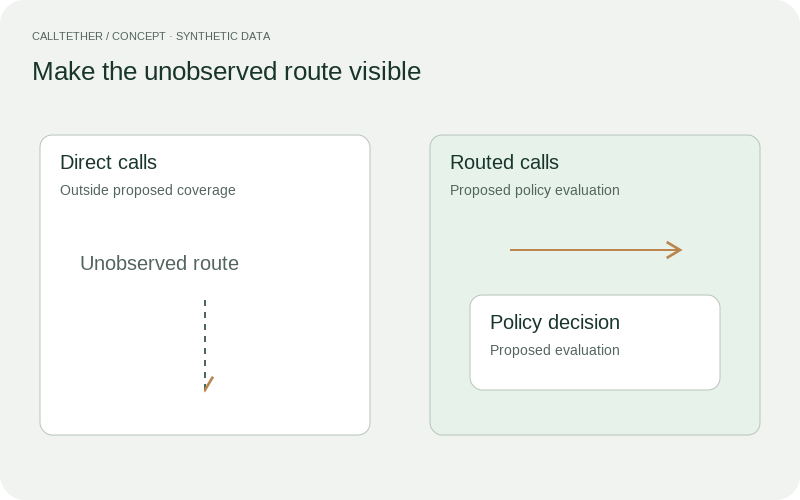
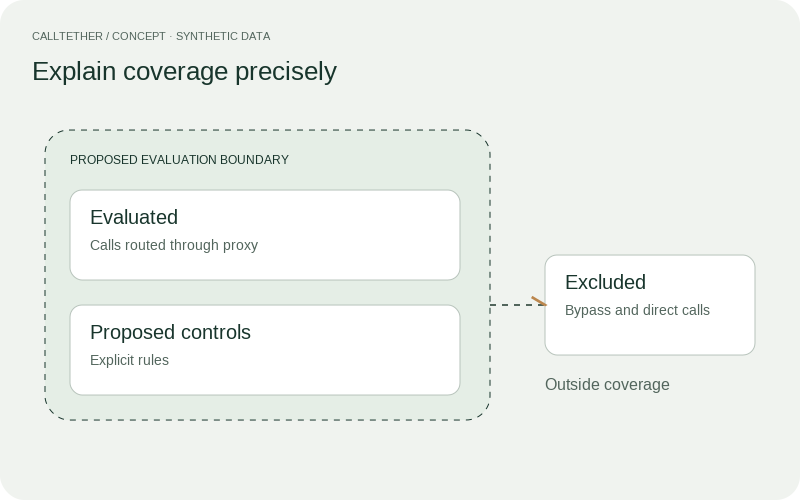
The proposed boundary evaluates agent tool calls routed through it, using the action, destination, and agreed policy context. Direct calls and unmonitored systems are outside that route.
A guided prototype walkthrough of a routed request, a policy check, a decision, and a reviewable record. All displayed data is synthetic.
This website presents a concept and product direction. Production capabilities, supported deployments, and availability have not been verified. A walkthrough can explore the proposed model.
Human approval is part of the proposed model. A scoped evaluation would define the reviewer, required context, and behavior when a review expires or an owner is unavailable.
Start by identifying one agent workflow and its route boundary. Agree on policies, success measures, and data handling before exploring a shadow-mode evaluation.
Coverage depends on routing. Only eligible calls passed through the proposed boundary are evaluated. It does not imply coverage of direct execution, manual access, or unconnected systems.
Bring one agent workflow. We’ll walk through the proposed route, its policies, and the decisions that matter.